


20 Days Direct to Europe! Arctic Route Launches Weekly Scheduled Operations
Source:
2026-07-29
As the 2026 navigation window for the Arctic route fully opens, this once "ice-bound experiment" of a Eurasian shortcut is completing a historic leap from "single trial voyages" to "weekly liner operations." Following the successful commercial maiden voyages by multiple Chinese shipping companies in 2025, this year has seen a substantial increase in capacity deployment and sailing frequency on the Arctic route, marking the official entry of Arctic container shipping into a new phase of large-scale and regular operations.
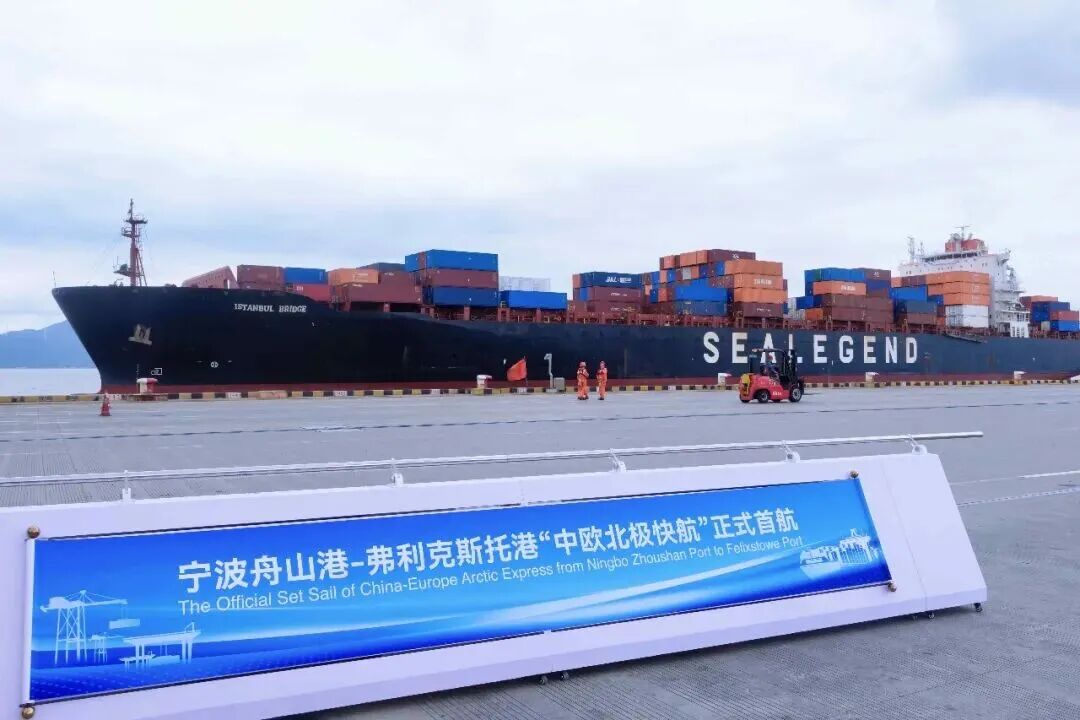
Commercial container shipping on China's Arctic routes began in 2025, with several companies successfully operating commercial voyages and receiving positive public feedback. The most symbolic milestone was the Arctic maiden voyage of the 4,890 TEU *Istanbul Bridge*, operated by Hai Jie Shipping. The vessel departed Ningbo-Zhoushan Port on September 23, 2025, and arrived at the UK's Port of Felixstowe in just about 20 days, significantly cutting the total transit time compared to the traditional Suez Canal route. The maiden voyage carried approximately 4,000 containers, and all slots were fully booked well before departure.
According to statistics from Norway's High North Logistics Center, the total number of transits along the Northern Sea Route (NSR) increased from 97 in 2024 to 107 in 2025—about five times the figure from a decade ago—with container ship transits rising from 11 to 15.
Entering 2026, the Arctic route has achieved a qualitative leap. In its latest weekly report, shipbroker Intermodal noted that China is moving from the successful trial voyages of 2025 toward regular container operations on the NSR.
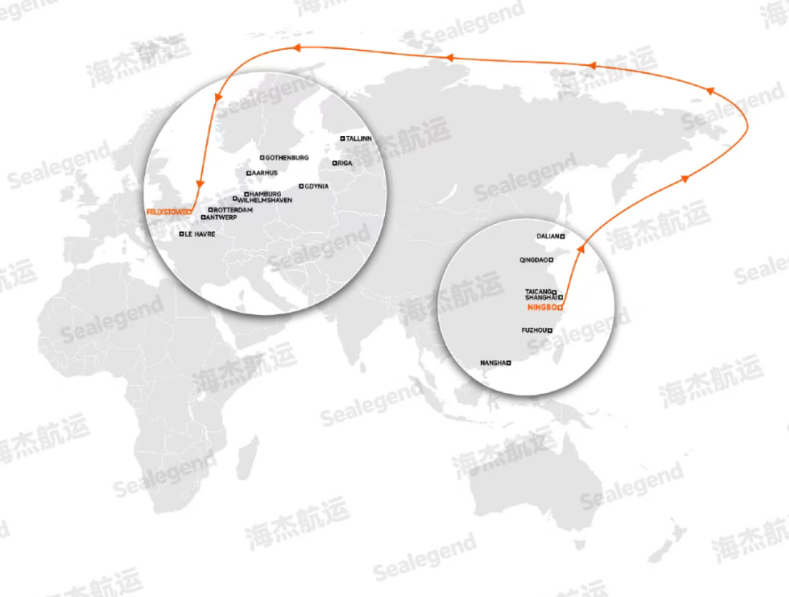
Earlier, the Ningbo Daily reported that, building on its maiden voyage, Hai Jie Shipping officially launched the CAX (China-Arctic Express) 2026 seasonal weekly service. From mid-August to early October, the company will operate eight fixed weekly sailings, deploying seven vessels with capacities ranging from 1,384 to 4,890 TEU, with an intended transit time of 20 to 22 days. The service follows an operational model of "multiple domestic port consolidation – Ningbo-Zhoushan – UK Felixstowe – optional direct calls to European ports." The domestic collection network covers Dalian, Qingdao, Shanghai, Taicang, Fuzhou, Nansha, and other ports, while Felixstowe serves as the main European hub, with feeder connections extending to key Northwest European and Eastern European ports such as Rotterdam, Wilhelmshaven, and Gdynia. The first sailing will be operated by the 1,740 TEU *Dubai Tower*, scheduled to depart Ningbo on August 15 and arrive at Felixstowe on September 5.
Some foreign media have commented that even global shipping giants like Maersk and CMA CGM have never achieved weekly Arctic service. Hai Jie Shipping, they note, "is not simply designing a trade route, but building an entire logistics framework."
Hai Jie Shipping is far from the only player on the 2026 Arctic route. Other operators participating in the first phase include NewNew Shipping Line, Ningbo Hongkun Shipping, Dalian Xingfeng Shipping, Tianjin Yueqian Shipping, and Shanghai Dahua Shipping. The deployed vessel types include container ships, dry bulk carriers, and multi-purpose vessels, with total container and multi-purpose capacity reaching 20,000 TEU and dry bulk capacity totaling 1.4 million deadweight tonnes. These vessels will depart in staggered schedules during the navigation window from late July to late September 2026, calling at multiple core domestic ports and heading directly to major European hub ports along the route.
Three Core Advantages of the Arctic Route
Compared to the traditional Suez Canal route and the Cape of Good Hope route, the Arctic route's integrated advantages are becoming increasingly evident.
Significantly shorter transit times:Taking the Shanghai–Rotterdam route as an example, the Arctic route saves approximately 3,000 nautical miles and about 15 days compared to the Suez Canal route, and about 6,800 nautical miles and 25 days compared to the Cape of Good Hope route. The sailing distance from Chinese ports to core Baltic ports in Europe is shortened by nearly one-third. By comparison, China-Europe rail freight typically takes about 25 days, traditional maritime transport via the Suez Canal takes 30 to 40 days, and routing via the Cape of Good Hope takes 40 to 50 days. Intermodal analyst Nikos Tagoulis pointed out that the route can cut voyage lengths by 30% to 40% for some Northeast Asia–Northern Europe services.
Safer and more stable transit:The Arctic route completely bypasses high-risk areas such as the Red Sea and the Strait of Malacca, effectively avoiding common hazards on traditional routes, including Suez Canal congestion, geopolitical tensions in the Red Sea, and piracy. Against the backdrop of rising transit costs through the Suez Canal and deteriorating security in the Strait of Hormuz, the market's demand for diversified logistics corridors has become more urgent than ever.
Natural low-temperature cold chain conditions:The Arctic route's low-temperature environment is well-suited for the temperature-controlled transport of high-value-added goods such as lithium batteries, photovoltaic products, precision machinery, and other high-value electronics, resulting in lower cargo loss rates. Hai Jie Shipping stated that its primary target cargoes include time-sensitive and high-value goods such as lithium batteries, photovoltaic products, new energy vehicle parts, and cross-border e-commerce merchandise.
Strategic Value Beyond Commercial Scale
Intermodal analyst Tagoulis believes that the significance of the Arctic route is particularly pronounced in the current geopolitical environment. He noted that amid rising geopolitical uncertainties and disruptions to global energy and trade flows, the value of alternative maritime routes may exceed their immediate commercial scale. The Northern Sea Route is not a direct response to events in the Strait of Hormuz, nor is it a broad substitute for the Suez Canal; however, despite its seasonal operations and limited capacity, it still offers a degree of transport optionality and reduces dependence on a handful of maritime chokepoints.
Tagoulis also pointed out that several major economies are expanding their presence on the NSR. Russia continues to ship Arctic LNG, crude oil, coal, and other bulk commodities to Europe and Asia via the route, supported by an expanding icebreaker fleet and state-backed infrastructure programs. China is testing the route's Eurasia connectivity under its "Polar Silk Road" framework, and South Korea is also accumulating operational experience through government-supported trial voyages.

Challenges to Scaling the Arctic Route
Despite significant progress, the large-scale development of the Arctic route still faces multiple constraints: the seasonal window is limited—currently the Arctic route is navigable only from July to October each year, making year-round operations impossible; infrastructure is weak, with most areas along the route lacking deep-water ports, safe anchorages, bunkering facilities, or emergency response capabilities.
Tagoulis concluded that the service's current significance is primarily demonstrative. The reliability of Hai Jie Shipping's operational plan will test whether regular Arctic services can be repeated rather than remaining one-off demonstrations. Successful execution would mark another step forward following last year's passage of the Istanbul Bridge and could support a specialised seasonal trade in the medium term.
According to data from Russia's Rosatom, total cargo volume on the Northern Sea Route in 2025 exceeded 37 million tonnes, with 1,565 transits recorded, a year-on-year increase of 16%. Container shipping completed 24 voyages, with cargo volumes doubling year-on-year. The CAX 2026 weekly service will further test whether the Arctic container express route can develop into a stable business model, providing the market with more real operational data.
Hot News